

Mr. Shahid Sattar, Secretary General, APTMA
Ms. Noreen Akhtar, Research Associate – Sustainable Development, APTMA
Pakistan’s exports-based economy is heavily reliant upon its textile sector. More than 60% of the country’s exports are textiles, and the industry employs 40% of the country’s labor force (International Finance Corporation n.d.). The industry is currently experiencing two crucial scenarios: High production costs due to the country’s poor economic performance and extrinsic pressure from the top export destinations in the form of mounting stringent compliance policies. While smooth financial performance is critical for the industry’s even functioning, the latter is a matter of survival.
The European Union (EU) is Pakistan’s top textile export destination, as 80% of the country’s exports to the EU are textiles (European Commission, n.d.a) (figure 1). Therefore, any policies implemented by the EU regarding its industrial imports are also majorly associated with Pakistan’s textile exports.
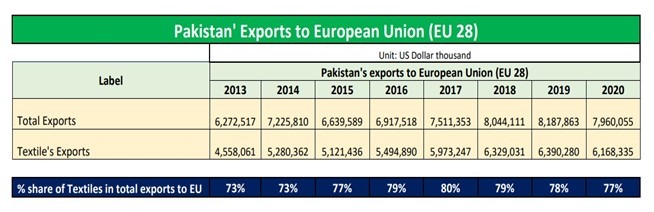
Figure 1. Pakistan’s exports to the EU.
Source: APTMA
EU has displayed serious commitment towards tackling climate change and has taken promising initiatives and legislative reforms to enhance environmental compliance via decarbonization in the industries. In the case of Pakistan, the EU has mandated the textile industry to comply with the mandatory international conventions on environment and climate change, which is compulsory for the GSP+ continuation. Further, a recent agreement on the Carbon Border Adjustment Mechanism (CBAM) is another milestone achieved to limit carbon emissions and prevent carbon leakage. CBAM is a climate measure that aims to reduce the carbon footprint of dirty products via a system of CBAM certificates. It also makes it obligatory for the EU importers to pay the same carbon price as domestic producers under EU Emissions Trading System (ETS). This “will ensure equal treatment for products made in the EU and imports from elsewhere and avoid carbon leakage” (European Commission 2021b).
CBAM is a more stringent climate policy that aims to enhance global efforts to combat climate change. The recent agreements on CBAM indicate that, with time, the international efforts to decarbonize manufacturing processes will rise, which will be gradually multiplied to the textile sector. Additionally, the global export market will become highly competitive for the exporters, such as Pakistan, with less stringent climate policies and carbon-intensive products. Based on its current industrial decarbonization policies, the EU will gradually phase out less compliant and competitive countries, and Pakistan is not far from experiencing this shock.
The textile sector’s environmental compliance in the increasingly competitive and demanding export markets is crucial, as failure to decarbonize will severely hinder Pakistan’s socioeconomic development and ecological sustainability. This is major because the EU’s preferential status (GSP+) for textile exports has supported Pakistan in enhancing its capabilities to grow sustainably, diversify its economy and create employment opportunities. It has accelerated the country’s efforts to improve compliance with major human and labor rights, environment, and good governance related to international conventions.
The industry’s current progress on decarbonization indicates that it has shown a promising commitment to achieving net zero by adopting a green supply chain philosophy. For instance, the Net Zero Pakistan initiative is Pakistan’s largest net zero coalition and is the only second country-wide program under Global Race to Zero after Japan. It is a collaborative effort between non-government organizations, leading textile companies, public institutions, and sector experts. The textile companies in this coalitioncommit to set science-based net zero targets, measure and disclose their GHG emissions, decarbonize their value chains, and advocate for climate action (Pakistan Environment Trust, n.d.). The rising coalition building under this initiative has become instrumental in catalyzing the net-zero ambition and is increasingly recognized globally as one of the first net-zero initiatives from the global south. The progress, however, indicates a slow pace.
The industry needs to take seriously into consideration the fact that the mandate from the global community of buyers to decarbonize the textile value chain is rising. Transitioning away from traditional energy sources to renewable energy sources has become obligatory. Therefore, Pakistan’s textile industry must reduce its carbon footprint by transitioning to clean energy sources by adopting long-term and sustainable pathways to decarbonization. The current efforts to meet the increasing energy demand from renewables must expand, and the existing technical capacity must be strengthened to utilize further solar, wind, thermal, and geothermal energy sources. This must take place in a very rigid time frame and requires the industry and the government to come together to ensure policy coherence by devising rigorous decarbonization frameworks for the industry that include financial and technical considerations.
Climate change severely affected Pakistan’s socioeconomic and environmental sustainability, thus exhausting the already deteriorating national economy. Failure to comply with global buyers’ increasingly stringent environmental policies and decarbonize manufacturing processes will worsen the failing economy. Therefore, the textile industry must expedite its progress and devise more rigorous and long-term climate policies to align with other regional export competitors. As decarbonization has become nonoptional, the industry must develop a comprehensive plan and strategy for meeting the global net zero targets to protect and expand Pakistan’s exports and the profitability of its companies.
REFERENCES
European Commission. n.d.a URL: https://policy.trade.ec.europa.eu/eu-trade-relationships-country-and-region/countries-and-regions/pakistan_en
European Commission. 2021b. URL: https://ec.europa.eu/commission/presscorner/detail/en/qanda_21_3661
International Finance Corporation. n.d. URL: https://invest.gov.pk/sites/default/files/inline-files/Profile%20-%20Textile%20Sector_new.pdf?gtranslate=en
Pakistan Environment Trust. n.d. URL: https://pakenvironment.org/net-zero-pakistan/

