
An multinational team of academics led by the University of Cambridge in the United Kingdom has created next-generation smart textiles that include LEDs, sensors, energy harvesting, and storage. Textiles may be made cheaply, in any form or size, using the same machinery that manufactures daily apparel.
According to the University of Cambridge, the team discovered that weaving electronic, optoelectronic, sensing, and energy fibre components on industrial looms used to make conventional textiles is more sustainable and cost-effective than using specialised microelectronic fabrication facilities that generate large volumes of waste.
The study’s findings, published in the journal Science Advances, demonstrated the promise of smart textiles as a feasible replacement for bulky electronics in industries such as automotive and fashion.
Current manufacturing procedures have constrained smart fabrics’ functionality, size, and forms. However, the same researchers proved last year that if smart textile fibres were coated with polymers that could survive stretching, they might be compatible with traditional weaving techniques. Using this technology, they produced a woven prototype display that measured 46 inches.
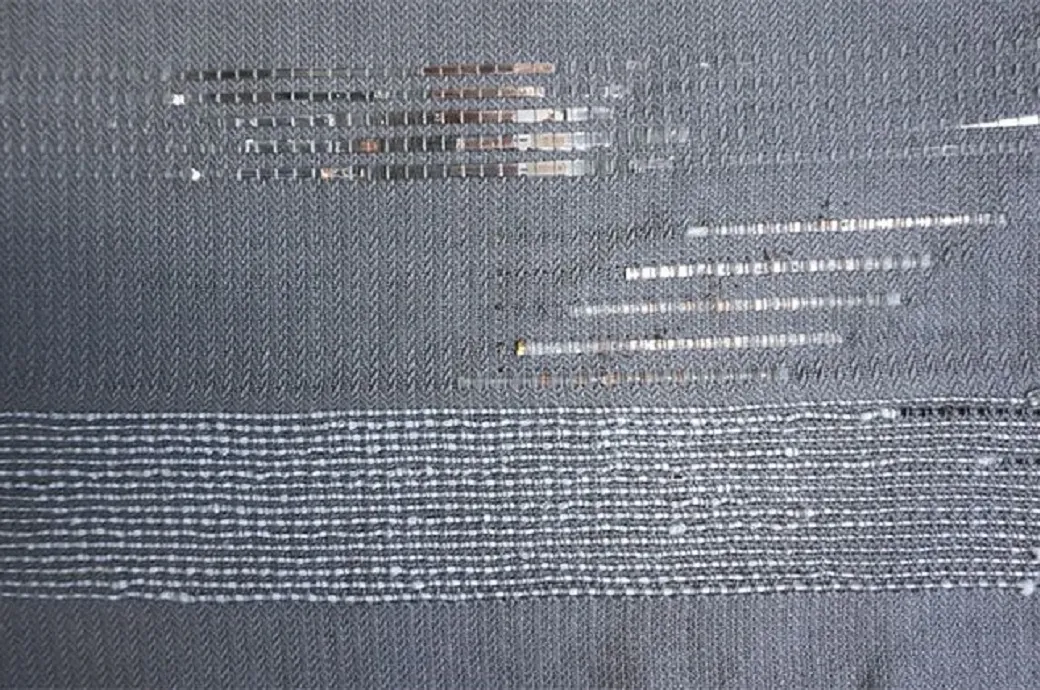
The researchers proved that automated procedures might be used to make any size or shape of smart fabrics. These smart textiles comprise various fibre devices, such as energy storage devices, light-emitting diodes, and transistors woven into regular fibres (synthetic or natural).
An automated laser welding process with electrically conductive glue is utilised to join the fibre devices. All methods were fine-tuned to minimise injury to the electronic components to make the smart fabrics capable of withstanding the stretching of an industrial weaving machine.
The encapsulating strategy was developed to account for the fibre devices’ performance, and mechanical force and thermal energy were carefully investigated to achieve automated weaving and laser-based connections.
The research team successfully constructed test patches of smart textiles sized roughly 50×50 centimetres through collaboration with textile producers. These fabrics’ manufacture may be expanded up to bigger proportions and mass-produced. According to the researchers, big and flexible screens and monitors might be manufactured on industrial looms rather than in specialised electronics manufacturing facilities, resulting in considerable cost savings. Additional process improvements are required.
The paper’s first author, Dr Sanghyo Lee of Cambridge’s Department of Engineering, stated, “We could make these textiles in specialised microelectronics facilities, but these require billions of pounds of investment.” Furthermore, because everything needs to be manufactured on the same hard wafers used to produce integrated circuits, the largest size we can reach is around 30 cm in diameter.
“These companies have well-established manufacturing lines with high throughput fibre extruders and large weaving machines capable of automatically weaving a metre square of textiles.” So, when we incorporate smart fibres into the process, the end product is essentially an electrical system made in the same manner as traditional textiles.”
“Smart textiles have also been limited by their lack of practicality,” said Dr Luigi Occhipinti of the Department of Engineering, who co-led the research. Considering the bending, stretching, and folding that typical material must resist, it is difficult to incorporate that same resilience into smart textiles.
“The flexibility of these textiles is incredible.” Not only in terms of mechanical flexibility but also in terms of approach and to deploy sustainable and eco-friendly electronics manufacturing platforms that contribute to carbon emission reductions and enable real-world applications of smart textiles in buildings, car interiors, and clothing. In that regard, our method is rather unusual.” The European Union and UK Project & Innovation contributed some funding.

