
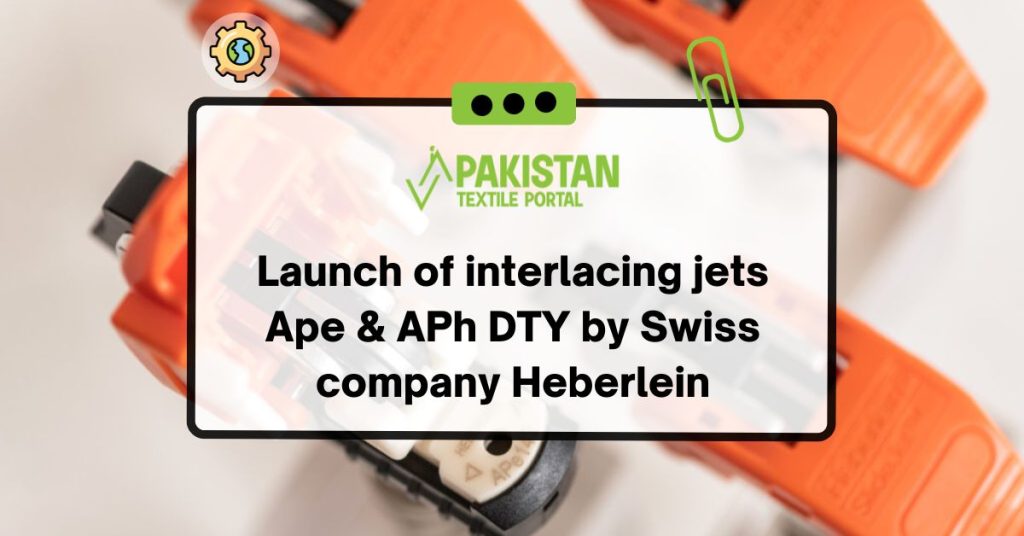
Heberlein, a major manufacturer of air interlacing and air texturing jets with headquarters in Switzerland, has introduced a new line of Advanced Performance DTY interlacing jets. While the APh jets exceed the strictest standards for knot stability, the APe series jets offer significant compressed air usage savings. Heberlein portrays these advances as alluring investments with the potential for high returns.
According to the International Textile Manufacturers Federation’s (ITMF) annual International Textile Machinery Shipment Statistics (ITMSS), the market started to slow down significantly in 2022. In 2022, shipments of draw texturing spindles decreased by 13% globally, with China accounting for 86% of the total. According to Heberlein’s personal experience with earlier slowdowns, such as those in 2007-2008 and 2020-2021, the DTY segment’s sales usually rebounded significantly afterward, the company noted in a news release.
DTY yarn producers whipped out their calculators when Heberlein introduced the new APe series at ITMA 2023. This series can lower compressed air use by 15% with the same number of knots. For instance, a texturizer in Italy calculated a cost reduction of $120 per day for a 288-position machine with a working pressure of 3 bar when replacing a P142 jet (P-series) with an APe142. The calculations were based on 0.12 KWh for 1 Nm3 of local electricity costs. In actuality, this resulted in a $5 hourly savings.
A texturizer can save roughly $1 per hour in China because energy costs there are lower than in most other regions. Heberlein relies on GlobalPetrolPrices.com for this calculation and assumes a price of $0.087 per kilowatt-hour (December 2 meridian). Additionally, it is based on the industry norm for costs, which is 0.12 kWh for every Nm3. Nm3 thus costs one cent, even though energy prices in China are notoriously volatile and heavily subsidized by the government on a national level. Based on 3bar and 24 hours, the actual cost reductions in China for a machine with 288 APe series jet locations come to $24.3 per day.
The $24.3 amount, however, needs to be viewed in the context of a Chinese manufacturing facility. In the Shanghai region, workers who work a 48-hour workweek are paid about $800 monthly. The DTY company saves $580 per machine (288 positions) with new APe jets for the same number of hours worked, which is roughly three-quarters of a worker’s comparable wage.
A potential tactic is to start saving now while also making preparations for the economic recovery. The numbers look terrific with the latest DTY air jet generation. A wide range of multifilament yarns can be interlaced using the APe air interlacing jets.
They result in faster processing speeds, better package construction, and fewer filament and yarn breaks during subsequent procedures.
Market participants interested in pursuing sustainable manufacturing through various means are also showing interest in the APe series. For instance, equal knot performance while using less energy offers sustainability without giving anything up.
Heberlein makes a substantial contribution to improved performance by manufacturers through the development and production of highly specialized critical components for process optimization in the processing of synthetic yarns, notably filament yarns. The development of the Advanced Performance jets has benefited greatly from the excellent insights that DTY experts have garnered using the most recent flow models.
Tests conducted in the company’s in-house textile lab and on-site at customers’ facilities support the new generation of jets’ improved production performance, which also enables considerable process optimization or energy savings in yarn manufacturing.
The textile business would prefer an upswing sooner rather than later. The APh interlacing jets offer the optimal starting point for gaining speed quickly and enabling maximum production output. The APh series satisfies the strictest criteria for knot stability and ensures exceptional performance without sacrificing yarn quality or process dependability.
For yarns generated by air covering in the 110 to 300 dtex range, the knot stability is likewise ensured. The APh jets function at their best during the finishing process, where yarns combined with elastane in particular are subjected to significant stresses. The APh series is the best option, especially for low filament counts, according to careful examination in the Heberlein textile lab. In summary, APh jets satisfy the highest standards for knot stability for all downstream processes—knitting, warp knitting, and weaving—thanks to their creative design.
Any investment decision requires thorough calculations, and Heberlein is delighted to assist potential clients with this effort. According to the press release, Heberlein advises non-binding consultations with its experts or first-hand knowledge at ITMA Asia 2023 (hall 8.1, stand A43).
The new APe and APh series are simple to install because they can be placed into the frequently used SlideJet FT15-2 and SwissJet housings, which are ideal for filament yarn producers who choose to reduce power usage and increase knot stability. The APe series’ plug-and-play design makes replacement simple and quick.

