

Mr Shahid Sattar, Secretary General, APTMA
Ms Noreen Akhtar, Research Associate – Sustainable Development, APTMA
Pakistan’s textile sector is experiencing a rising requirement from the global community of buyers to enhance environmentally and socially sustainable practices. To fulfil this, Pakistan’s textile industry must widely adopt ESG (Environmental, Social and Governance) practices and solutions.
ESG has emerged as a more proactive movement that ensures a holistic approach to sustainability in the industry. It is a framework that supports the industry in managing environmental, social, ethical, and governance-related risks and opportunities. Unlike the previous sustainability-focused regulatory frameworks such as EHS (Environmental, Health and Safety), Corporate Sustainability and CSR (Corporate Social Responsibility), ESG focuses widely on the critical environmental and social elements and governance structures. It ensures the representation of all the stakeholders interested in learning about the industry’s approaches to ensure sustainability. These stakeholders include the investment community, customers, suppliers, and employees (Peterdy, 2022).
OVERVIEW OF THE ESG PILLARS
Environmental
This pillar includes the industry’s considerations of the environmental impacts of its business and practices to manage the associated risks (Mathis 2022; Peterdy 2022). Some examples include direct and indirect GHG emissions, climate change, hazardous chemical discharge and water pollution, waste pollution and natural resource depletion. The management practices include natural resource management, decarbonization and energy management, effluent treatment and hazardous waste management, to name a few.
Social
The social pillar addresses the industry’s relationship with its stakeholders (Peterdy, 2022). It endorses the ethical and socially conscious themes in the industry. This includes employee well-being, such as health and safety and fair wages, and the industry’s impacts on the communities where it operates. Other significant examples Mathis (2022) stated include data privacy, robust labour standards, compliance with human rights, employee equity and inclusion and customer satisfaction.
Governance
ESG’s third pillar deals with the accuracy and accountability of the industry’s leadership. It focuses on the best compliance practices and transparency of the companies. Governance examples may include company leadership, corruption and bribery, political lobbying, audit committee structure, internal control, and regulatory policies (Mathis, 2022).
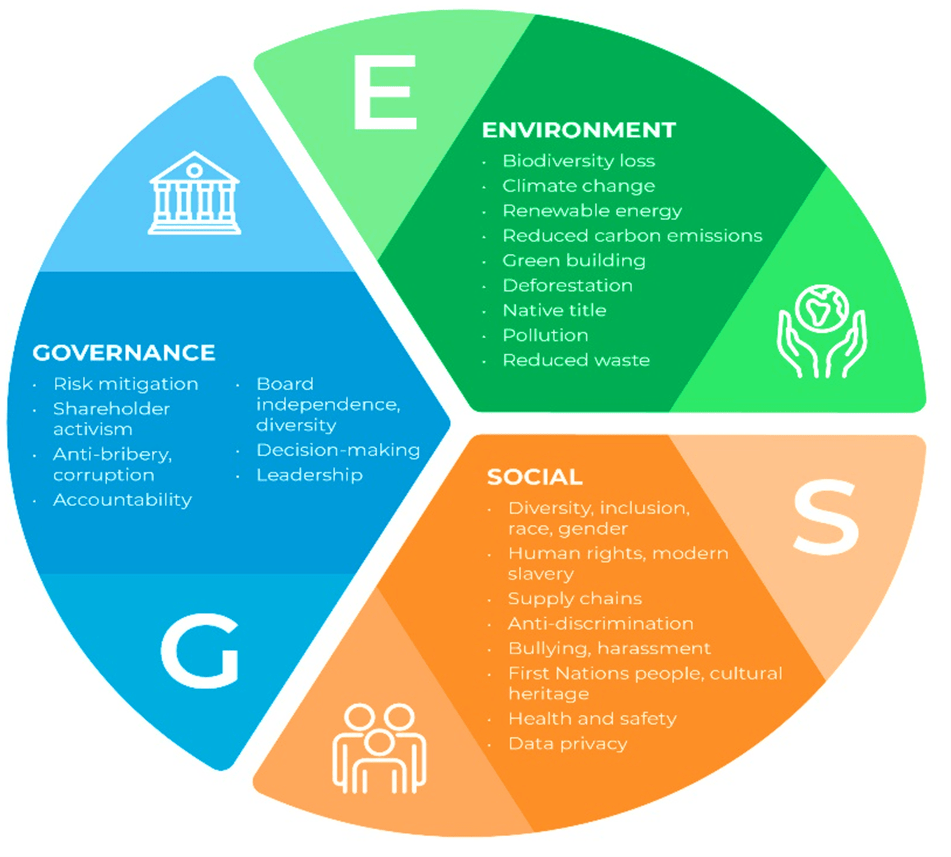
ESG areas of concern (Farnsworth et al. 2022).
ESG AND PAKISTAN’S TEXTILE INDUSTRY
The global community’s demand for sustainability in the textile industry has reached a stage of critical importance. Compliance with the international conventions on human rights, labour rights, environment and good governance has become non-optional for the industry to maintain its competitive position. This compliance via ESG principles is a ‘win-win’ situation for the industry. The industry will boost its business in the international market, ensure stakeholders’ rights, and fulfil its responsibility towards mitigating risks to the natural environment.
Pakistan’s textile industry has shown significant progress in fulfilling its social and environmental responsibilities. Even though the country’s major policy interventions, such as the National Climate Change Policy (NCCP), Nationally Determined Contributions (NDCs) and the Textile Policy 2020-2025 do not clearly emphasize social and environmental sustainability in the industry, sustainability has been a bottom-up approach, led by the industry itself. The industry has aligned its current and future strategies with the UN-SDG principles, from acquiring international compliance certifications such as GOTS, Oeko Tex, and BCI to promoting internationally recognized initiatives to achieve net zero targets and employee well-being.
The efforts, however, need coherence under the umbrella of the ESG framework. The industry needs to come together to find aggregate solutions and impose coherent policies to ensure sustainability in the sector. Although international rules, norms and markets have been the significant pathways of influence for the industry to go sustainable, the motivation to compete in the global market should also come from intrinsic values. These may include collective approaches for capacity building and coalition building to make the country’s textile sector socially and environmentally sustainable.
High-Impact Priority Areas
The following are some high-impact priority areas that require the industry to scale up its ESG solutions: Raw materials, climate, chemicals, sustainability measurement, fair labour, engaging consumers and innovation and circularity (Accenture 2022).
The priority ESG solutions associated with the raw materials include the reduction of GHG emissions associated with the raw material production, enhanced traceability and use of internationally certified raw materials. Regarding climate, the industry must set targets to achieve net zero emissions, adopt energy efficiency measures and set emissions reduction pathway plans. Hazardous chemical management is another high-impact priority area which requires compliance with the ZDHC requirements, transparent reporting on chemical use and hazardous chemical discharge, a solid commitment to ensure wastewater management and eliminate hazardous chemicals, regular testing of wet processing facilities and transparent auditing.
Best practice benchmarking; development of comprehensive sustainability strategies, governance and goals; quantifying progress tracking on ESG goals and publicly reporting sustainability progress and transformation efforts are some of the significant ESG solutions for sustainability measurement. Further, fair labour to protect workers’ rights is another crucial priority area that demands ESG solutions from the textile industry. These include fair compensation programs, responsible recruitment, empowerment and education programs and respect for human rights and health and safety standards. Consumer engagement includes communicating progress on ESG goals to the consumers, formulating standards for communicating the ESG impacts of products, engaging consumers in developing sustainability solutions, providing traceability data, and educating consumers about the industry’s ESG commitments. Under the ESG framework, innovation and circularity require the industry to develop and execute circular economy strategies and action plans and invest in innovative circular business models.
CONCLUSION AND FURTHER WORK
Pakistan has already shown promising progress in aligning its development with the UN SDGs and international requirements. However, current social and environmental sustainability efforts need to be accelerated by adopting ESG solutions in the textile sector. The relevant stakeholders must come together and find aggregate solutions to support the sector’s flourish in the increasingly competitive global markets. ESG practices that ensure a holistic approach to safeguarding the natural environment and human well-being and strengthening governance structures must be adopted widely, coherently, and effectively. This is only possible when the sector develops a long-term ESG vision.
Significantly, the All Pakistan Textiles Mills Association (APTMA) suggests that strengthening the governance structure is a crucial element of ESG that helps enhance sustainability measurement. One part of this is to regulate the sustainability assessments and inspections conducted by the national and international compliance bodies by developing standards based on the mandates of the UN conventions on human rights, labour rights, environment and good governance.
Pakistan needs to legislate a central authority at the federal level to compile and standardize all compliance requirements and to regulate the functioning of all the compliance bodies. This central authority will be responsible for issuing guidelines for the compliance bodies to perform sustainability assessments based on the requirements by the international treaties on human and labour rights as well as the environment and good governance. The statutory body will also issue guidelines, with minimum requirements, for the legal enrollment and registrations of the compliance bodies and follow tripartite consultations as mandatory procedures during their assessments. The statutory body will provide an appeal forum to address concerns petitioned by the tripartite partners and resolve any disputes.
Pakistan is currently experiencing a plethora of compliance bodies. The functioning of these bodies is crucial for the industries, as they are mandated to acquire certifications to maintain their export markets. These certifications have also motivated industries to enhance compliance and fulfil social and environmental responsibilities. However, the compliance bodies are functioning without a central statutory body responsible for monitoring their operations in the industry. This absence of legal monitoring of the compliance bodies is a threat that not only projects a little picture of the sustainability progress of the country but also functions without a tripartite consultation, which is crucial to understand the local nuances. Significantly, the global community’s demand for sustainability in Pakistan’s industries has reached a stage of critical importance. Compliance with the international conventions on human rights, labour rights, environment and good governance has become non-optional for the country to maintain its competitive position. In these critical times, when Pakistan needs to project its sustainability and compliance progress vigilantly, these unlawful inspections by the compliance bodies might cause grievances in the industry.
Pakistan must formulate a statutory body that regulates and monitors all the compliance bodies by issuing national compliance standards.
The primary responsibility of this statutory body will be to issue guidelines for industrial compliance based on the mandatory requirements by the UN conventions on human rights, labour rights, environment and good governance, standardized for Pakistan to fulfil. The statutory body will also issue guidelines, with minimum requirements, for all the compliance bodies for their legal enrollment and registrations. Notably, the statutory body will make tripartite consultations mandatory for the certification bodies to consider during their inspections. The tripartite partners, generally the government, employers and workers, will have the authority to appeal against unlawful, undisciplined and unfair inspections. This will take place through an appeal forum provided by the statutory body that will address concerns petitioned by the tripartite partners and resolve any disputes among them.
The statutory body will legally bind all the national and international compliance bodies to align their inspections with its guidelines and standard procedures for assessing the industries in a regulated and acceptable manner.
The formation of this statutory body will be a milestone achieved by Pakistan to project its sustainability progress in a realistic and disciplined manner.
REFERENCES
Accenture. 2022. Scaling ESG solutions in fashion. URL: https://www.accenture.com/_acnmedia/PDF-176/Accenture-Retail-Scaling-ESG-Solution-2022-Edition-Full-Report.pdf
Farnsworth, G. et al. 2022. Environmental, Social and Governance (ESG) explained: Five critical considerations for companies and their lawyers. Holding Redlich. URL: https://www.holdingredlich.com/environmental-social-and-governance-esg-explained-five-important-considerations-for-companies-and-their-lawyers
Mathis, S. 2022. Environmental, Social and Governance (ESG). TechTarget. URL: https://www.techtarget.com/whatis/definition/environmental-social-and-governance-ESG
Peterdy, k. 2022. ESG (Environmental, Social and Governance). Corporate Finance Institute. URL: https://corporatefinanceinstitute.com/resources/esg/esg-environmental-social-governance/


For smaller textile businesses, ESG reporting becomes more practical when a few operational records are standardised first: supplier identity, fibre composition, dye-lot data, water or energy use where available, and corrective actions. Consistent batch-level records can make buyer due diligence more credible without forcing SMEs to begin with an overly complex reporting system.