
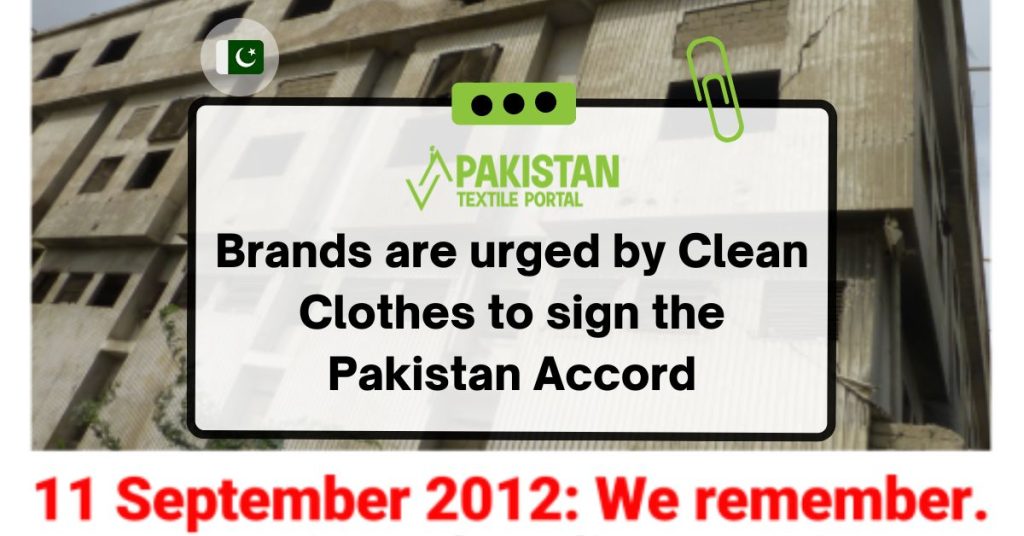
KARACHI: To encourage brands to join the Pakistan Accord, the Clean Clothes Campaign (CCC) has used the 11th anniversary of a fire in a Pakistani textile factory. In September 2012, a fire at the Ali Enterprises clothing factory in Karachi resulted in the deaths of over 250 workers, prompting calls for improved social audit measures in the area. The International Accord for Health and Safety in the Textile and Garment Industry introduced the Pakistan Accord garment plant safety program in 2022.
The enforceable program has data on more than 400 manufacturers that supply signatory brands. A worker safety awareness program, remedy monitoring, training for the safety committee, and an independent complaints procedure are all included. Gap, a US clothing giant, is one of the most recent signatories, bringing the total to 72 as of the beginning of August.
“Today, our thoughts are with all those who were harmed by the deadly fire, the survivors, some of whom were forced to jump from upper floors to save their lives, and the families who lost their loved ones, in many cases the breadwinners,” the CCC said in a statement, adding that the fire also illustrated the shortcomings of social audit systems used by many brands. “The social auditing companies that inspect factories on behalf of buyers or factories themselves to check the working conditions in garment and textile factories are utterly insufficient to find and address real worker rights violations,” says the report. Just a few weeks before the fire, the Ali Enterprises factory had received worldwide social certification standards compliance certification.
However, it took the enormous tragedy of the Rana Plaza collapse in Bangladesh in 2013, a decade of safety work in Bangladesh, and years of struggle by unions in Pakistan for a transparent and legally binding safety program like the Pakistan Accord to finally materialize. According to the CCC, the fire at Ali Enterprises demonstrated conclusively that voluntary, brand-led systems do not work.
The general secretary of the Pakistani organization for home-based female workers, Zehra Khan, continued, “The falsified guarantees of the auditors who visited the Ali Enterprises plant shows that all audit reports ought to be made public. Private social auditing is only employed to deceive consumers into believing everything is fine in the factories.
“To ensure that audits are worker-centered and result-oriented, they must be conducted by a tripartite, legally-binding audit system with union participation.”
The CCC also noted several significant companies and shops that have yet to commit, even though dozens of firms have now signed the agreement.
Brands including Target Australia, Esprit, and Fruit of the Loom, as well as Boohoo, The Very Group, and Missguided from the UK, have consented to programs comparable to those in Bangladesh but not yet in Pakistan. In addition, some companies have a sizable sourcing presence in the region but have not ratified the agreement in Bangladesh or Pakistan. IKEA, Levi’s, Kontoor Brands (Lee, Wrangler), Amazon, Target US, and Decathlon are a few of these, according to CCC.

