
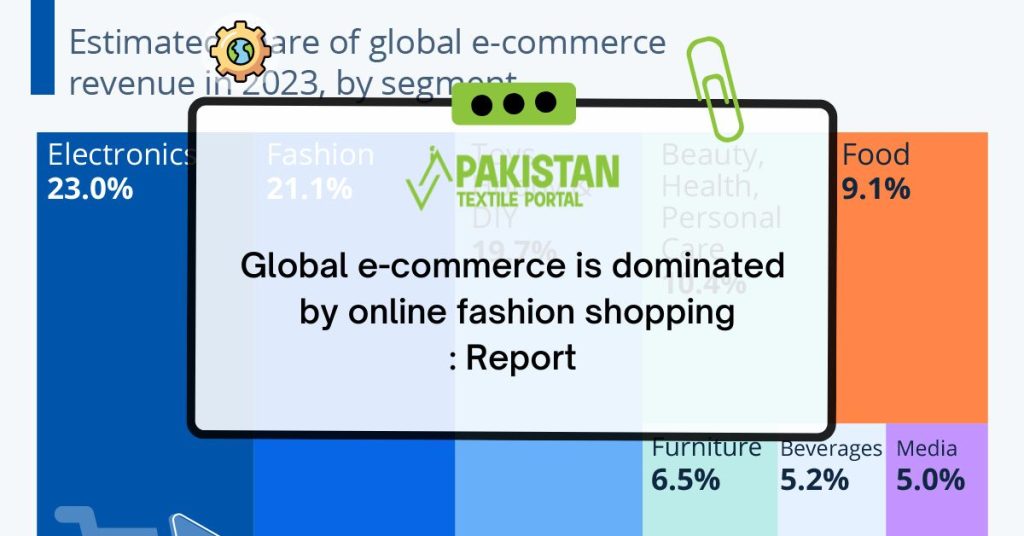
According to the most recent ConsumerX 2024 research, online fashion shopping is driving global e-commerce, with 56.1% of respondents buying apparel and accessories online. Just 3.1% of respondents to the extensive study, which included 7,714 respondents, said they never purchase online, highlighting the increasing popularity of this activity.
37.8% of online shoppers make purchases at least once a month, and 34.1% shop online more frequently than once a week. The main motivations for people who would rather not shop online are that they feel safer in real stores (23.6%) and that they prefer to shop in-store (29.5%).
4.8% of respondents are concerned about delivery problems, and 8.9% of respondents are concerned about the security of online payments. Furthermore, the report states that 8% of respondents merely had no prior experience with online buying.
Convenience and cost savings are the obvious reasons why customers shop online. Home delivery (42.8%), time savings (384.4%), lower costs (386.6%), and attractive deals (33.3%) are the main justifications. In addition to these, other major criteria include having access to a greater variety of products (26%), reading product reviews before to making a purchase (19.7%), and having more product information (14.5%).
Remarkably, 20.2% of participants believe that purchasing online requires less work. Health concerns (4.2%) and safety (5.5%) are less frequently mentioned, despite the fact that more consumers purchase online for safety than they do in-store. The study emphasizes how quickly online shopping has developed—a technological invention that was hardly conceivable before the close of the 20th century. In response to the evolving demands of consumers, new retail technologies are still being developed today. The ConsumerX 2024 study explores how consumers in Europe and other regions are utilizing retail technologies. The most popular technology was social commerce, which allows users to purchase goods using social media platforms. Of the respondents, 27.2% reported using it in the previous year.
With a utilization rate of 25.8%, live shopping—which involves making purchases through livestream broadcasts including product demonstrations—follows closely behind.
16.1% of respondents said they had used emerging technologies like virtual shopping assistants and AI-powered bots that provide product suggestions, and 15.2% said they have tried augmented reality to see things in their homes. Merely 11% of participants reported utilizing voice shopping with gadgets such as Google Voice Assistant or Amazon Alexa in the previous year, indicating a reduced adoption rate. Merely 7.6% of participants utilized the metaverse, a virtual reality platform for e-commerce. It’s interesting to note that 45.2% of respondents said they had not used any of these technologies in the previous year.
The majority of consumers anticipate that their favorite brands will use these technologies in the future, although 28.7% do not think they will be available anytime soon. With 32% of respondents anticipating its implementation, augmented reality is the area of highest curiosity. This is because companies like DFS and Lego, which already use AR to demonstrate products, have sparked this enthusiasm. Furthermore, 27.5 percent anticipate live shopping becoming more commonplace, and 28.6 percent anticipate virtual shopping assistants. The percentages of interest in voice shopping (18%) and metaverse shopping (16.5%) are lower.

