
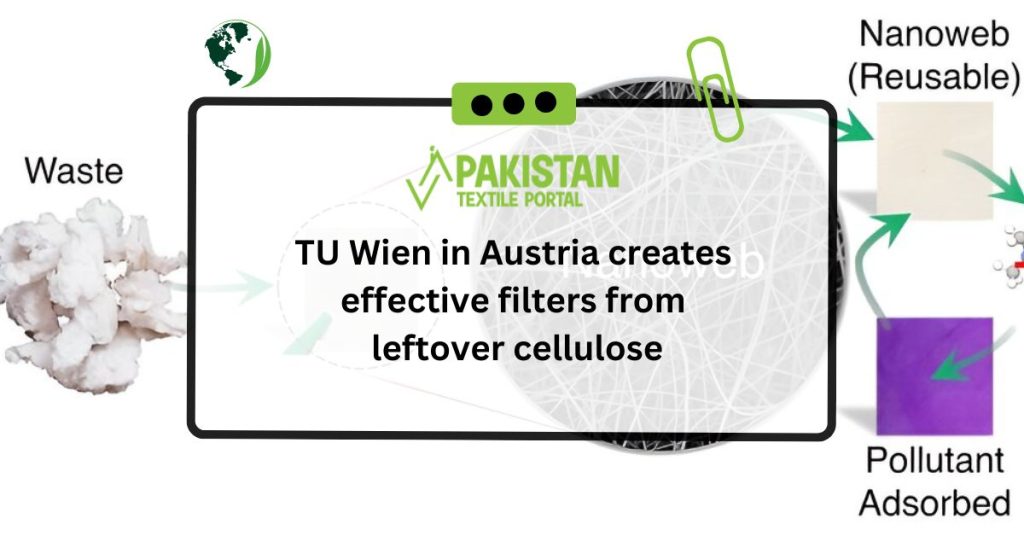
Effective filters made from cellulose waste have recently been created at TU Wien. A unique type of nanostructure has been created to remove a common class of dangerous dyes from water. A material that is regarded as waste—used cellulose, such as that found in paper cups or cleaning cloths—is an essential component. A fine nano-fabric is coated with cellulose to produce an effective filter for contaminated water.
The majority of synthetic dyes, including so-called azo compounds, are classified as organic dyes. Even in nations where environmental protection is not given much thought, they are widely utilized in the textile sector, and the colors frequently wind up in unfiltered wastewater.
Professor Gunther Rupprechter of the TU Wien Institute of Materials Chemistry stated, “This is dangerous because such dyes degrade very slowly, they can remain in the water for a long time and pose great danger to humans and nature.”
These colors can be bound by a variety of substances. But it is insufficient on its own. “If you simply let the polluted water flow over a filter film that can bind dyes, the cleaning effect is low,” Rupprechter said. “It’s much better to create a nanofabric out of lots of tiny fibres and let the water seep through.” This exposes a significantly greater surface area to the water, increasing the number of organic dye molecules that can be bonded.
“We are working with semi-crystalline nanocellulose, which can be produced from waste material,” stated Qaisar Maqbool, a postdoc in Rupprechter’s research group and the study’s first author. “Substances containing metal are frequently employed for related objectives. However, our material may also be made by upcycling used paper, and it poses no environmental impact at all.” To create nanostructures, this nano-cellulose is “spun” with the plastic polyacrylonitrile. But a great deal of technical talent is needed for this. Using a technique known as electrospinning, the TU Wien team achieved success. During this procedure, liquid material is sprayed; electrically charged droplets are then propelled through an electric field.
“This ensures that the liquid forms extremely fine threads with a diameter of 180 to 200 nanometers during curing,” Rupprechter stated. These strands combine to create a thin, highly porous tissue known as a nanoweb. One square centimeter can contain a network of threads with a surface area of more than 10 cm^2.
These cellulose-coated nanostructures performed extremely well in the tests: Ninety-five percent of the violet color was eliminated from the water after it underwent three cycles of purification. “The nanoweb continues to hold the dyes. Then, you can regenerate the web, dissolve the colors that have been stored, and reuse the filter cloth, or you can dispose of the entire thing,” Rupprechter said.
More work must be done, though, in order to evaluate the complex nanowebs’ mechanical qualities, test for biocompatibility, determine how sensitive they are to increasingly complicated contaminants, and achieve scaling to industrial-grade standards. Rupprechter and his research group now wish to look at the possibilities of applying this dye filter technology to other fields. “The medical industry may find great use for this technology. For example, filtering out highly particular chemical components from a liquid is also necessary for dialysis,” Rupprechter said.

